
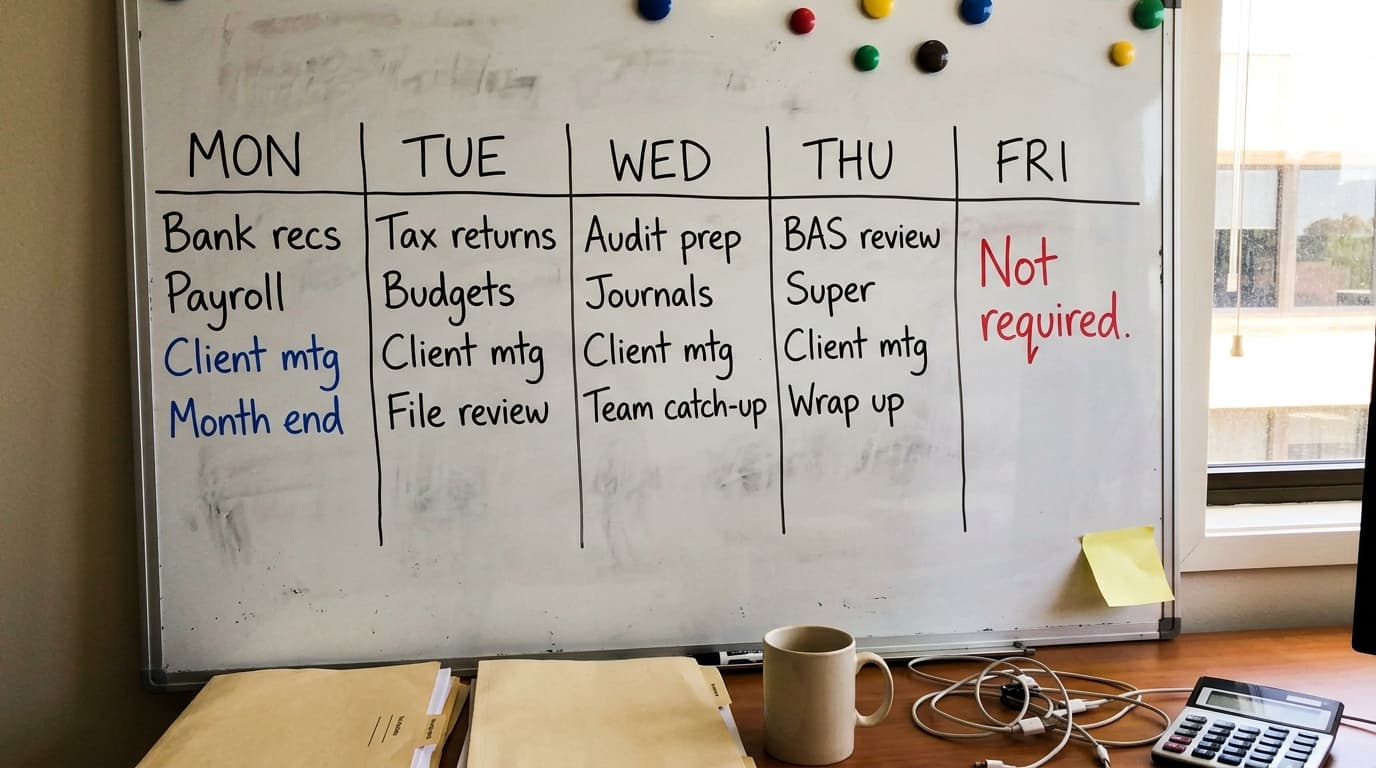
Executive summary
AI can give some time back to people in professional firms, and the four-day work week is one of the ways a firm could use it. This piece looks at what has happened to productivity and working hours since Keynes, what the four-day week trials found and where they fall short, what a shorter week means for firms that bill by time, and where a firm can look for that time across its whole team.
The economist John Maynard Keynes thought that within a hundred years, people's real problem would be "how to occupy the leisure, which science and compound interest will have won for him". He wrote it in 1930, and suggested a fifteen-hour week might be enough work to keep people content for a while. We told the story of how Australian working hours came down, and then stopped coming down, in Value, time and productivity.
AI raises a similar question for firms that are starting to save time on parts of their work. People in firms have spent the last few years working out which parts of their jobs AI can take on. What we tend to see is time coming back in small pieces, spread across the day and across the team.
1Hours, productivity and the time saved
By the June 2026 quarter, labour productivity was flat for the quarter and down 0.2% on a year earlier, while hours worked across the economy had risen 2.3%, according to the Productivity Commission. Reporting the previous quarter's figures in June, the Commission's Deputy Chair, Alex Robson, said: "In aggregate, we are working harder and longer, but we are not working smarter."
In August 2025, 31% of employed Australians usually worked extra hours or overtime, according to the Australian Bureau of Statistics. Among people who usually worked from home, 21% gave catching up on work after hours as one of the reasons. A poll of 1,001 employed Australians for the Centre for Future Work, part of the progressive think tank The Australia Institute, found employees did 3.6 hours of unpaid work on average in the week surveyed, rising to 4.1 hours for managers and professionals.
Jobs and Skills Australia set out in its 2025 study of generative AI where saved time can go. The hours can be "redeployed within the same task or in other related or different tasks in the organisation, recouped by the worker as leisure time", or they can reduce hours of employment.
In Denmark, Anders Humlum and Emilie Vestergaard matched survey answers from about 25,000 workers, including accountants and legal professionals, to official records. In their March 2026 paper, 85% of chatbot users said they moved the time they saved to other job tasks. Fewer than 10% said they used it for breaks or leisure. The records showed no measurable change in hours worked or earnings.
In a national survey of 3,577 Australian adults by the ANU School of Cybernetics, in partnership with Google, 72.2% of people who used generative AI agreed it saved them time. Among them, 63.2% agreed they had used the time for free personal time, and 58.1% for more of the same work. People could agree with more than one, and the survey covers adults who are not working as well as those who are.
In a randomised trial of Microsoft 365 Copilot with 7,137 knowledge workers in 66 firms, people who used the tool cut their time on email by two hours a week and worked slightly less outside regular hours. Some of the researchers worked for Microsoft, which makes Copilot.
2The four-day week
In 2025 the ACTU called for a shorter working week, arguing, as the Parliamentary Library summarises it, that "workers should benefit from productivity gains and technological advances".
The best-known version of a four-day week is 100:80:100: 100% of the pay for 80% of the hours, with the aim of keeping 100% of the output. That is the model the Senate Select Committee on Work and Care asked the Australian Government to trial in 2023. In June 2024 the Government noted the recommendation and said claims for a four-day week trial had not been agreed in Australian Public Service bargaining.
A compressed week keeps the full hours and fits them into four longer days. A nine-day fortnight spreads the change over two weeks. Grant Thornton Australia made a nine-day fortnight permanent in May 2024 with no cut to pay. In the firm's own internal survey, 94% of its people supported the change.
The trials below mostly tested the 100:80:100 model, with fewer hours for the same pay.
3What the trials found
In August 2022, 26 companies began a four-day week pilot run by 4 Day Week Global, an advocacy group, with the research done by Juliet Schor, Wen Fan and Guolin Gu at Boston College. Ten of the companies were in Australia and nine in New Zealand, and six were professional services firms. Of the 758 people who took part, 547 completed both the starting and finishing surveys. Burnout fell for 64% of employees, and sick and personal days fell 44.3%. Of the 20 companies that said whether they would continue, 95% wanted to keep the four-day week. The report gives no figure for the other six.
The same researchers, with Orla Kelly, later published a peer-reviewed study in Nature Human Behaviour in July 2025. It covered 2,896 employees across 141 organisations in Australia, New Zealand, Canada, Ireland, the UK and the US, all on a four-day week with no cut in pay. Each organisation reorganised its work before a six-month trial. The study found improvements in burnout, job satisfaction, mental health and physical health, "a pattern not observed in 12 control companies". People whose own hours fell further tended to see bigger improvements. The researchers traced the gains to three things: fewer sleep problems, less fatigue, and people rating themselves more able to do their work.
A trial funded by the Portuguese Government looked at which companies stayed on four days. Of the 41 companies, four returned to a five-day week at the end. The chance of going back was 8% among companies that made two or more changes to how they organised work, and 38% among those that made one or none.
A 2023 review of earlier pilots for the European Commission's Joint Research Centre pointed out that the companies volunteered, most results compare before with after, and people may work differently because they know they are in a pilot. Participants were concentrated in IT, telecoms and professional services, and the review recommended treating the results "solely as indicative data". The Parliamentary Library describes the results as "mixed" and notes that "most trials results are based on employee-reported data". It also records that Unilever and Bupa discontinued their Australian trials, with Unilever saying "there's no one-size-fits-all approach to flexibility".
In Tasmania, the City of Launceston proposed a 30.4-hour week over four days for its staff from July 2026. In February 2026 it stepped back to flexible 38-hour arrangements, including compressed four-day weeks and nine-day fortnights, and said it would establish a working group to model the costs and service impact before revisiting the proposal.
AI Uplift Program
Find the time before you plan it
The investigation times your firm's work task by task and shows where AI could free up time. You keep the findings, whatever you decide.
4Firms that bill by time
The billable hour. In a firm that charges by the hour, fewer hours worked can mean fewer hours billed, unless the work per hour rises or the firm prices some of its work differently. We looked at those questions in AI and the billable hour.
Client deadlines and cover. On a shorter or compressed week, a client matter keeps moving on a person's day off when a colleague can pick it up. Grant Thornton kept all six of its offices open five days a week while its people moved to a nine-day fortnight.
Decision load. Professional work runs on judgement calls, and a compressed week fits the same calls into longer days. When we looked at decision fatigue, we found the research mixed. The Nature Human Behaviour study looked at reduced hours, and in that setting less fatigue and better sleep were part of how wellbeing improved. Compressed weeks are a different arrangement, and a firm trying longer days would need to watch how its people cope with them.
Workload. In the 2025 Victorian Lawyer Census, "perceiving workload as unacceptable was the single strongest predictor" of both distress and burnout, and 53% of the Victorian lawyers surveyed were at risk of burnout. We look at burnout in law and accounting separately.
5Flexibility
With billing, cover and workload to weigh up, a firm can treat the four-day week as one option among several, alongside other kinds of flexibility. In August 2025, 30% of Australian employees had an agreement to work flexible hours, and 36% of employed people usually worked from home. Under the Fair Work Act, some employees, including parents of children of school age or younger, carers and people aged 55 or older, can request a change to their hours, pattern or location of work. The employer has 21 days to respond and can refuse only on reasonable business grounds. After-hours contact has its own rules, which we cover in AI and the right to disconnect.
In a randomised trial at a Chinese technology company, published in Nature in 2024, two days a week working from home cut quit rates by a third among 1,612 employees, and made no difference to performance grades over the following two years.
Depending on the team, the time could go to:
a four-day week, or a nine-day fortnight, for a team whose work allows it
flexible start and finish times, so school pick-up or a medical appointment can fit around client work
protected time for work that needs sustained concentration
training junior staff, with time to talk through the judgement behind the routine work AI handles
shorter days in a quieter season, after a heavy one
Without a shared plan
- Saved time is handled person by person
- No agreed purpose for time saved by AI
- Handover arrangements vary
- Flexibility is worked out case by case
With a shared plan
- Saved time measured across the team
- The firm agrees which options it can support
- Handover approach agreed
- Flexibility options documented by team or role
6Finding the time with AI
Five steps to start with:
Measure the work as it is.
Ask the team where their hours go and which tasks take longer than they should. A short AI audit can show what people are already using and where AI is saving time.
Look for the repeated work.
File notes, matter summaries, standard letters, meeting notes, invoice queries. Start with repeated tasks that occur across the team. Capture useful prompts or methods so other people can reuse them, in a prompt library or wherever the team already keeps its precedents.
Build the handover.
A day off is easier to cover when a matter can move without its owner. AI can help draft an end-of-day matter summary from the file, or a handover note before leave, for the person covering to check and pick up. Agree the format as a team, so the person covering knows where to look.
Decide where the time goes before it is saved.
Agree with the partners which arrangements the firm can support, and how each one sits with billing.
Try it with one team and measure again.
Pick a team, an arrangement and a set period. Measure the same tasks again at the end, and ask the team how it went, before deciding whether to extend it.
7Where we come in
Our investigation times your firm's work task by task, so you can see where AI could save time, where the repeated work sits, and how much room there might be to give back. The findings belong to your firm whether or not we go any further together.
If you would like to work out what the time AI gives back could mean for your people, reach out to our team. The first conversation works out whether your firm is the right fit for the AI Uplift Program, and whether we are the right people to help.
Finding the time to give back
Frequently asked questions
What is a four-day work week?
It usually means a working week of four days. In the 100:80:100 model, people keep 100% of their pay for 80% of the hours, with the aim of keeping 100% of the output. A compressed week keeps the full hours over four longer days, and a nine-day fortnight spreads the change over two weeks.
Does a four-day week work?
Trials have reported lower burnout and better wellbeing. A peer-reviewed study of 141 organisations found improvements that were not seen in 12 comparison companies. The organisations volunteered, most results are self-reported, and some companies, including Unilever and Bupa in Australia, discontinued their trials.
Has Australia trialled a four-day week?
Ten Australian companies took part in the 4 Day Week Global pilot from August 2022. A Senate committee recommended a government trial in 2023, which the Government noted without adopting. The City of Launceston proposed a four-day week for its staff and in February 2026 moved to flexible 38-hour arrangements instead.
Can a law or accounting firm move to a four-day week?
Some professional services firms have tried shorter or compressed weeks. A firm that bills by time would need to think through billing, client cover and workload, and the trials so far have included professional services firms only as part of wider samples.
Can AI help create room for a shorter working week?
Potentially. AI can reduce time on some repeated tasks and help with handovers, but the firm still has to measure where time is being saved and decide what to do with it.

About the author
Julia leads the investigation and is the author of the report presented to your leadership. Her background is in research, data analysis and business strategy.
Primary sources
This article is general information about how firms organise their work and their use of AI. It is not legal advice, and any change to hours or working arrangements should be checked against your firm's awards, agreements and the National Employment Standards.