
Executive summary
Decision fatigue is the idea that each decision a person makes wears down the ones that follow. This piece covers what the research shows and what it does not, how AI changes the decisions people in professional firms make each day, and what a firm can do about the load.
Firms are already handing AI some of the small work: first drafts of emails, meeting notes, file summaries, the reformatting at the end of a long document. People in law and accounting practices have been working out which of those jobs AI does well, and for many of them it has taken real weight off the day.
Along with the work, AI takes some of the small decisions off their plates. How to word the reply to an invoice query. Which parts of the meeting go in the notes. What order the file summary should run in.
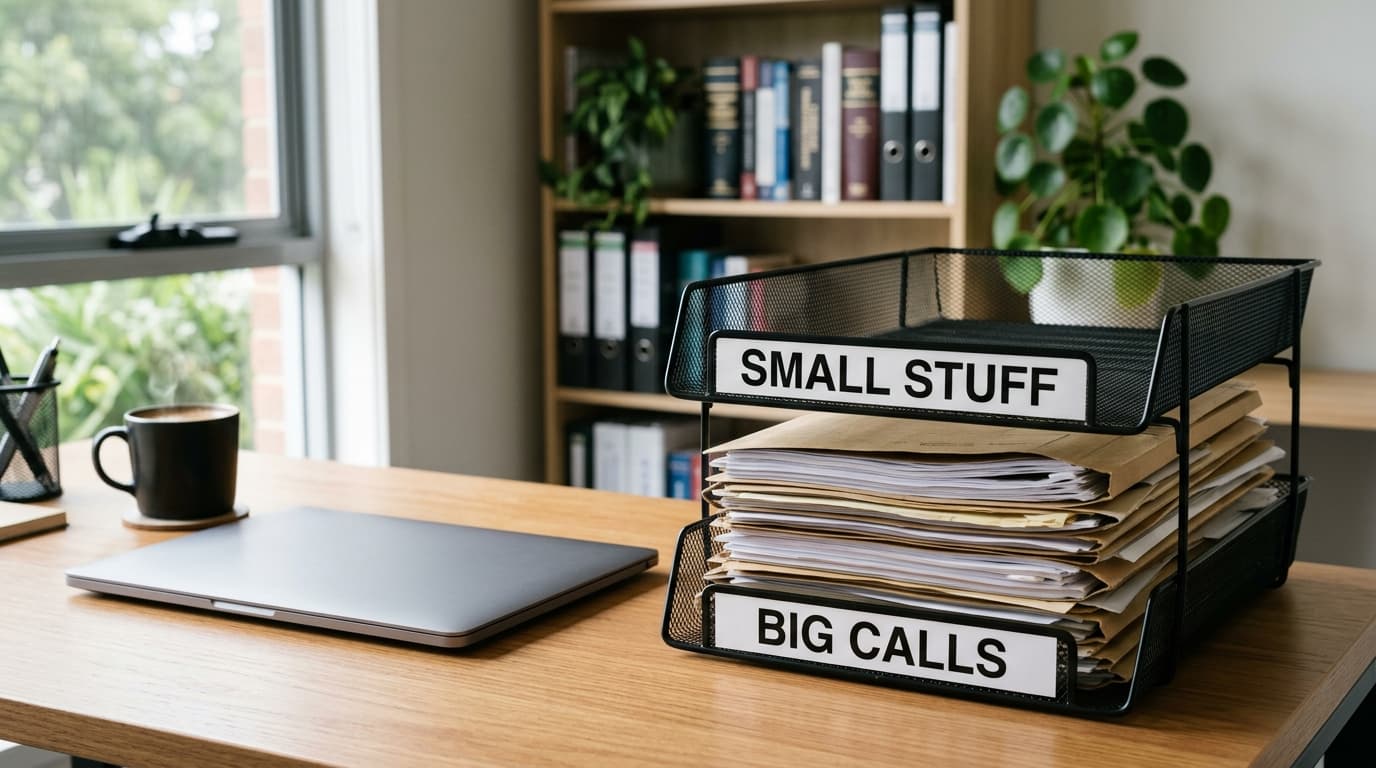
In 1973, Alan Lakein's How to Get Control of Your Time and Your Life sorted tasks into A, B and C: A for the ones that matter most, B for the ones that can wait, and C for the small ones. If AI takes on more of the Bs and Cs, a person's day fills up with more of the As.
So should we be making more A decisions and letting AI take care of the B and C tasks? But what does that do to a person who spends the whole day on big decisions?
If you plan how work runs in a law or accounting firm, these questions may already be showing up in how the week gets organised.
1What decision fatigue means
Decision fatigue is the idea that making decision after decision wears down the quality of the decisions that come after. In its best-known form, each of us has a certain number of good decisions in us each day, and every choice uses some of them up. The idea went mainstream in August 2011, when John Tierney wrote about it in the New York Times Magazine.
In 2012, Barack Obama told the writer Michael Lewis in Vanity Fair: "You'll see I wear only gray or blue suits. I'm trying to pare down decisions. I don't want to make decisions about what I'm eating or wearing. Because I have too many other decisions to make." Two years later, Mark Zuckerberg told a public Q&A that he wore the same grey T-shirt every day because he wanted to make "as few decisions as possible about anything except how to best serve this community", as CNBC reported.
Some of the most cited evidence comes from medicine. In 2014, Jeffrey Linder and colleagues looked at 21,867 visits for respiratory infections across 23 primary care practices in the United States, published in JAMA Internal Medicine. Clinicians prescribed antibiotics steadily more often as a four-hour session went on. By the fourth hour, the adjusted odds of a prescription were 26% higher than in the first.
A study of Australian GPs found a similar pattern on a much larger scale. Mona Maier and colleagues analysed 262,456 consultations with 2,909 GPs and found that for every 15 more patients a GP had seen, the odds of an antibiotic prescription rose by 8.7%, while prescriptions for statins and osteoporosis medication fell.
Neither team measured fatigue directly, and the time of day could also stand for ordinary tiredness, running late, or the kind of patient who books a late appointment.
The laboratory experiments behind the idea of a daily supply of willpower have been repeated in large studies across dozens of labs, with the methods registered in advance, and the effect shrank to very little or to nothing (Hagger and colleagues, 2016; Vohs and colleagues, 2021). In 2025, Swedish researchers tested the idea on 231,076 real calls to a nurse advice line, and the data favoured no change in the nurses' decisions across a shift or after a break. A review of 82 studies of healthcare professionals found that fewer than half of the tests supported decision fatigue. Even the famous study of Israeli parole judges, whose rulings seemed to turn harsher as a food break approached, is still argued over, because the cases were not heard in random order.
So where does that leave it? Long stretches of demanding work do wear people down, and some professional decisions have been seen to change as a session goes on. The tidy version, with a fixed number of good decisions a day, has not held up. A firm can look at how the working day is set up around those decisions.
2A day of A decisions
Say a senior associate in a commercial team gets an afternoon back. The first draft of the letter is done, the file summary is ready, and the notes from the morning's client meeting are already in the matter. What's left on her list are the calls that need her judgement: the advice to sign off, the risk to weigh up, the figure she will put her name to.
The closest evidence on a day of big decisions comes from auditors. Bart Dierynck and Christian Peters ran three experiments with more than 350 professional auditors, published in Contemporary Accounting Research in 2026. In the first two, auditors who started with the easier task generally did worse overall than those who started with the harder one. In the third, where the auditors chose their own order, they tended to start with the easier task, and more so under time pressure.
Stress has its own effect. A 2016 meta-analysis by Katrin Starcke and Matthias Brand found stress tends to push people towards riskier decisions, particularly where the risk is a poor bet. In a review of the research on sleep, Yvonne Harrison and James Horne found that sleep loss hit hardest the decisions that need fresh thinking: dealing with the unexpected, changing a plan when new information arrives, and weighing up risk. Logical, rule-based reasoning held up better. A 2024 meta-analysis of 44 studies found that even one short night left people sleepier and more prone to lapses in attention, though it found no clear effect on working memory.
In a firm with a heavy season, or a big matter running late, the same person can be under time pressure, short on sleep and making the biggest calls of the week.
AI adds a few small calls to that load. Each time a person opens an AI tool, there are decisions to make first: which one to use, what information is allowed in, and how far to trust what comes back. Checking the result is a decision too, and a demanding one. We looked at the research on that checking load in What a four-minute job costs, and at who does the checking in Are you the human in the loop?
When AI makes room in the day, what should the room be for?
AI Uplift Program
Know where the judgement calls sit
The investigation shows where the decisions in your firm's work land, and how long the work takes today. You keep the findings either way.
3More decisions, or better ones
With AI, should we be making room so people can make more decisions, or so they can make better ones? The research can't settle it yet, and it is probably a bit of both.
Giving each decision more thought adds the most value where one judgement carries the client's outcome: the advice on a dispute, the structure of a deal, the position taken on a tax return. In a randomised experiment with 273 business professionals working on a time-pressured market-entry decision, Matteo Cristofaro and colleagues found that how people used AI shaped the quality of the decision. They saw the strongest thinking and the fewest biases at a moderate level of AI use, where people compared and questioned what the AI gave them. Very light and very heavy use both did worse.
The room can also go to more decisions. A firm with clients waiting, or a team short of people, may need the extra capacity.
Or some of the time could go somewhere else altogether, such as training junior staff: sitting with them on a file, talking through why a call was made, reviewing their work together. As AI takes on more of the Bs and Cs, juniors may see fewer of the routine tasks that build judgement.
What does it look like when a firm gets this right? People know which decisions are theirs and which the firm has already settled. The hardest call of the day gets a fresh hour. The small AI calls are made once, for the whole team. People have time to recover between big decisions, and the firm has decided what the room AI makes is for, whether that is more client work or time back for the team.
Each of those is set by the firm as a whole, through the tools it approves, the way it allocates work and what it decides the saved time is for.
Decisions left to the day
- AI clears the Bs and Cs, and more As fill the space
- Each person makes their own calls about AI
- The hardest call lands whenever it lands
- Time saved goes back on the list
Decisions planned for
- AI clears the Bs and Cs, and the firm decides what the space is for
- The routine AI calls are settled once for everyone
- The hardest call gets a fresh hour
- Some of the time goes to recovery and to training juniors
4Planning for decision load
Talk about it as a firm
Decision fatigue is a phrase many people recognise, and the research behind it is more mixed than its reputation. Share what holds up and what doesn't, and ask your team where the decisions pile up in their week.
Make it visible in how work is planned
When work is allocated, look at the number of sign-offs and judgement calls landing on one person in a day, as well as the hours. A heavy week of approvals can look light on a timesheet.
Put the hard call first
Where people can choose, put the biggest decision of the day ahead of the easier work, as the auditor experiments suggest. People also think best at different times of day, although the research is mixed: a 2025 review of 65 studies found performance was better at a person's preferred time of day in 45% of studies of adults aged 18 to 45, and in 83% of studies of older adults. So let people choose when in the day they tackle it, where the work allows.
Leave room to recover
Breaks can lift energy and reduce fatigue, as we set out in Working smarter with AI, not just faster. The nurse study found no change in decisions after a break, so a break is best treated as time to recover. Late-night work matters here too, given what a short night does to attention. We look at after-hours work in AI and the right to disconnect.
Settle the small AI calls once
Decide as a firm which tools are approved, what information can go into each, and which outputs are checked, by whom and how closely. Each one the firm settles comes off your people's list every time they open the tool. Set the defaults with care. In a 2026 audit experiment, defaults that pointed to the likely right answer made people faster and more accurate under load, and defaults that pointed the wrong way made them less accurate. Setting good defaults is part of what a shared prompt library is for.
5Where we come in
Our investigation maps how your firm's work runs today and measures how long it takes, including where the judgement calls sit and who they land on. The findings belong to your firm whether or not we go any further together.
If you would like to see the decision load in your firm, and what AI is changing about it, reach out to our team. The first conversation works out whether your firm is the right fit for the AI Uplift Program, and whether we are the right people to help.
Planning for decision load
Frequently asked questions
What is decision fatigue?
The idea that making decision after decision wears down the quality of the decisions that follow. Some large field studies, including one of Australian GPs, have found decisions changing over a session, although none measured fatigue directly.
Is decision fatigue real?
Long stretches of demanding work do wear people down, and some field studies have seen professional decisions change over a session. The stronger version, a fixed number of good decisions a day, has not held up well. A 2025 study of 231,076 calls to a Swedish nurse advice line found no sign of it, and a review of 82 healthcare studies found fewer than half of the tests supported it.
Why did Obama and Zuckerberg wear the same clothes every day?
Both said they wanted fewer small decisions. Obama told Vanity Fair in 2012 that he wore only grey or blue suits to "pare down decisions", and Zuckerberg said in 2014 that he wanted to make as few decisions as possible about anything except his work.
Does AI reduce decision fatigue?
It can take small decisions off a person's list, and it adds some of its own, such as which tool to use, what information is allowed in, and how far to trust the answer. Research on the overall effect is still early.
How can a firm reduce decision load?
Settle the routine AI decisions once for the whole firm, put the hardest decisions ahead of the easier work, leave time to recover, and look at the number of judgement calls landing on one person as well as their hours.

About the author
Julia leads the investigation and is the author of the report presented to your leadership. Her background is in research, data analysis and business strategy.